
You have narrowed it down to two SUVs. Same model year, similar mileage, and the sticker prices are within a few hundred dollars of each other. You pick the one in the color you like, sign the paperwork, and call for insurance. The number that comes back is higher than you expected, and higher than a friend pays for the SUV you passed on.
It happens all the time, and it is not random. The car itself is one of the biggest pieces of an auto insurance price, and it is the one piece you still control before you sign. Here is what drives the difference and how to compare before you choose.
Why the Car Changes the Price
When a carrier prices your policy, it looks at you (your driving record, your age, your insurance history) and at the car. For the car, carriers generally consider how likely it is to be in a claim and how expensive those claims tend to be. That comes down to a handful of factors:
Repair costs. Parts, labor, and how the car is built all affect what a fender bender costs. Modern bumpers often hold cameras and sensors that need to be replaced and recalibrated after even a minor hit.
Claim history for that model. Carriers track how often a given make and model is involved in claims and how much those claims cost. The Highway Loss Data Institute publishes insurance loss results by make and model, which shows how much these numbers can differ between vehicles that look similar on paper.
Injury results. Some vehicles tend to produce more or costlier injury claims than others, which affects the liability and medical portions of the price.
Theft. Vehicles that are stolen more often, or whose parts are targeted, can cost more to cover for comprehensive.
Value. A more expensive car costs more to replace if it is totaled, which affects comprehensive and collision.
No single factor decides the price, and each carrier weighs them differently. That is exactly why two cars that seem identical at the dealership can be priced differently at the insurance company.
What Stays the Same No Matter Which Car You Pick
Some parts of your price follow you, not the car. Your driving record, your claims history, the drivers in your household, and the coverage you choose all carry over to whatever you buy.
Where the car is parked overnight matters too. Rates are generally filed by territory, so a car garaged in one ZIP code can be priced differently from the same car a few miles away. If you are moving between neighborhoods in Columbus or Dayton around the time you buy, give your agent the address where the car will actually live.
The legal requirement does not change with the car either. Every vehicle you drive in Ohio needs at least the liability limits set by ORC 4509.51(B): $25,000 per person and $50,000 per accident for bodily injury, and $25,000 for property damage. If you are financing, your lender will also require comprehensive and collision, as we explained in our guide to what full coverage your lender requires.
How to Compare Before You Choose
A side-by-side insurance comparison takes a few minutes and can change which car makes sense. Here is how to do it:
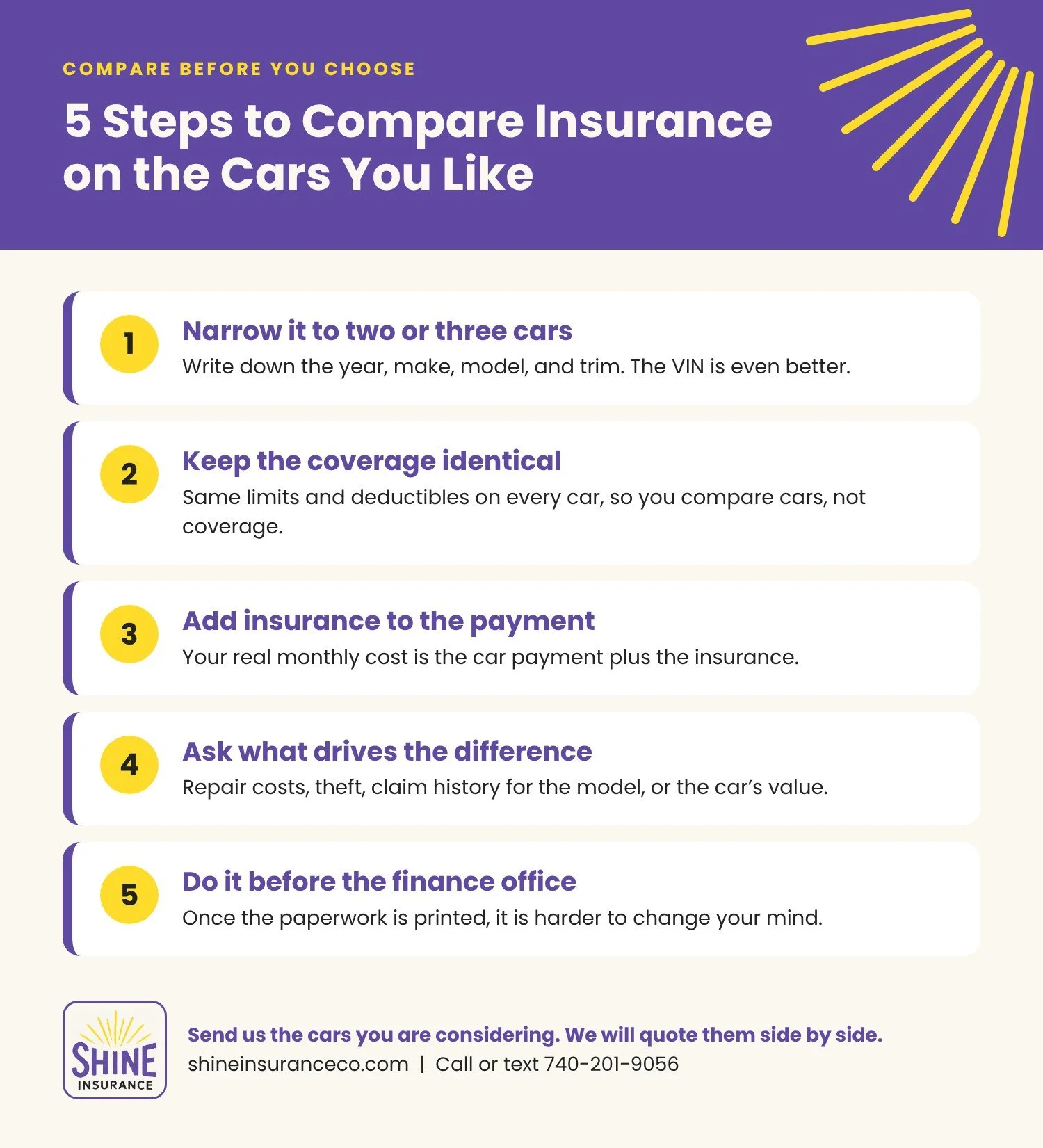
Narrow it to two or three cars. Write down the year, make, model, and trim for each. The VIN is even better, since trim and equipment can change the price.
Keep the coverage identical. Ask for the same limits and the same deductibles on every car, so you are comparing the cars and not the coverage.
Add the insurance to the payment. Your real monthly cost is the car payment plus the insurance. A car with a slightly lower payment can end up costing more each month once insurance is included.
Ask what is driving the difference. A good agent can usually tell you whether the gap comes from repair costs, theft, or the car's value.
Do it before the finance office. Once the paperwork is printed, it is much harder to change your mind.
Why an Independent Agency Helps Here
A single insurance company gives you one view of each car. Because Shine Insurance is an independent agency, we can quote the same cars across multiple carriers, which matters because carriers weigh vehicle factors differently. The car that is pricier to insure with one company may not be with another.
We also work with carriers that can help when your own history makes things harder, whether that is tickets or claims on your record, a need for an SR-22 filing, or a foreign driver's license. We move fast once we have a completed quote request, and if the dealership is open, so are we.
Compare Before You Commit
Still deciding? Send us the cars you are considering, or call or text 740-201-9056 with the year, make, and model of each. Let's find out which one fits your budget before you sign!
This article is general information about Ohio auto insurance and is not legal advice. Pricing depends on the carrier, the vehicle, the drivers, and the coverage selected. Your policy documents control.