
You have been approved for the loan, the payment fits your budget, and the finance manager says the last step is "full coverage." You nod, because everyone says it. Then you call around for a quote and realize you are not sure what you are supposed to be asking for.
You are not alone. "Full coverage" is one of the most common phrases in car buying, and it does not appear anywhere in an auto insurance policy. Here is what it actually means, what your lender can require, and what happens if your coverage slips during the loan.
"Full Coverage" Is a Nickname, Not a Policy
When a dealer or lender says full coverage, they almost always mean a policy with three pieces:
Liability: pays for injuries and property damage you cause to other people. This is the part Ohio law requires on every car.
Comprehensive: pays for damage to your car from things other than a crash, such as theft, hail, fire, flooding, a falling tree, or hitting a deer.
Collision: pays for damage to your car when it hits another vehicle or object, or overturns, regardless of who is at fault.
Even with all three, a policy is never truly "full." Every policy has limits, deductibles, and exclusions. That is why it is worth knowing what is on yours instead of trusting the nickname.
Ohio Requires Liability. Your Lender Requires the Rest.
The state and your lender are asking for two different things, for two different reasons.
Ohio's requirement protects other people on the road. Under ORC 4509.51(B), the minimum is $25,000 per person and $50,000 per accident for bodily injury, plus $25,000 for property damage. Ohio does not require comprehensive or collision on any car.
Your lender's requirement protects the car, because the car is the collateral for the loan. Until the loan is paid off, the lender has a financial stake in that vehicle. If it is stolen or totaled and there is no physical damage coverage, the lender has nothing to recover. So the loan contract makes comprehensive and collision a condition of the loan. That requirement comes from your contract, not from state law, which is why it can vary from one lender to the next.
What Your Loan Contract Will Usually Spell Out
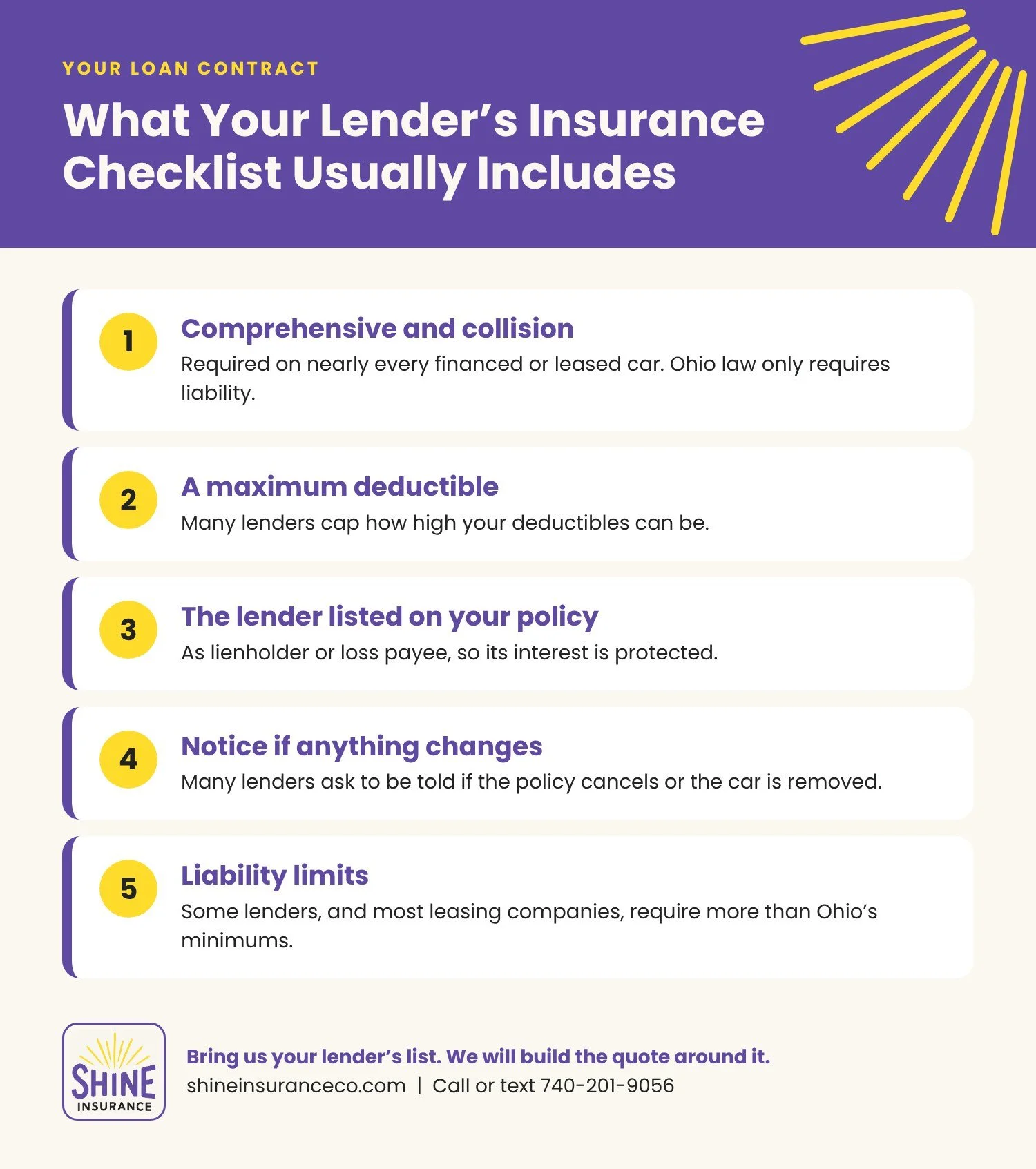
Most auto loan and lease agreements include an insurance section. Look for these items, because they tell you exactly what your policy has to show:
Comprehensive and collision on the financed car. This is nearly universal for financed and leased vehicles.
A maximum deductible. Many lenders cap how high your comprehensive and collision deductibles can be. Choosing a higher deductible can lower your premium, but going above the lender's cap can put you out of compliance with your contract.
The lender listed as lienholder or loss payee. This means a check for a covered physical damage claim can be made out to both you and the lender, so the lender's interest is protected.
Notice of changes. Many lenders ask your insurer to notify them if the policy is canceled or the car is removed.
Liability limits. Some lenders and most leasing companies set liability limits above Ohio's minimums. Leases in particular often require higher limits.
If you cannot find the insurance section, call the lender and ask, "What are the insurance requirements on my account, and what is the maximum deductible you allow?" Then give that answer to your agent.
What Happens If Your Coverage Lapses
This is the part most buyers never hear about until it happens.
If your comprehensive and collision coverage cancels during the loan, for a missed payment, a policy change, or a switch between companies that did not line up, your lender will usually find out. Most loan contracts give the lender the right to buy coverage on the car and add the cost to what you owe. This is called force-placed or collateral protection insurance.
According to the Consumer Financial Protection Bureau, force-placed insurance is typically much more expensive than coverage you buy yourself, and it protects only the lender. It does not cover your liability to other drivers, so you could still be driving illegally under Ohio law.
The fix is to keep your own policy active with no gaps. If you are switching insurance companies, have the new policy start the same day the old one ends, and make sure the lender is listed on the new one before the old one is canceled.
Coverage Your Lender Will Not Require (but You Should Ask About)
A lender cares about the car. You should also care about you. These are not required by most lenders, but they are worth a conversation:
Uninsured and underinsured motorist coverage for your own injuries when the at-fault driver has little or no insurance.
Medical payments coverage for medical bills for you and your passengers, regardless of fault.
Rental reimbursement so you are not stranded while your car is in the shop after a covered claim.
Towing and roadside assistance.
GAP protection, offered in the finance office, if you owe more than the car is worth. We explain how it works and when it makes sense in an upcoming post.
Make the Lender's List Your Quote Checklist
The simplest way to handle all of this is to bring your lender's requirements to the quote, not the other way around. When you request a quote from Shine Insurance, tell us your lender's name and any deductible cap. We will build the quote to fit the contract, compare options across multiple carriers, and send proof of coverage with the lender listed directly to the dealership or lender.
Let's Get It Right the First Time
Start your quote request or call or text 740-201-9056. Worst case, you learn your current policy already checks every box on the lender's list.
This article is general information about Ohio auto insurance and is not legal advice. Your loan contract sets your lender's requirements, and your policy documents control your coverage.